
Cold Emailing Template
Good cold emails are short, specific and about the recipient, not you. This builder turns a few details — who they are, a problem they likely have, how you help and one piece of proof — into a first email and two polite follow-ups, then checks length and wording before you send.
- Free to use
- No sign-up
- Runs in your browser
Cold email template builder
Cold Email Toolkit
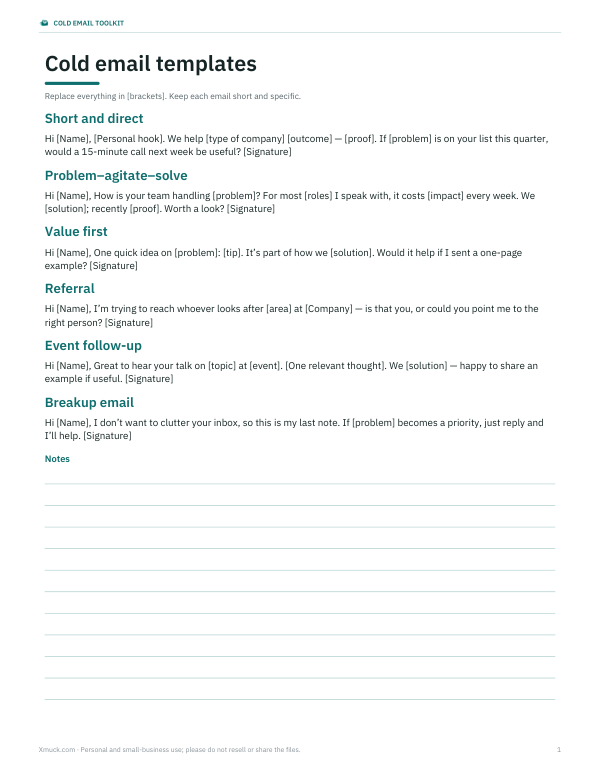
Editable cold email templates for six scenarios, a subject line swipe file, an outreach tracker spreadsheet, a prospect research sheet and a pre-send checklist.
- Email templates (DOCX/PDF)
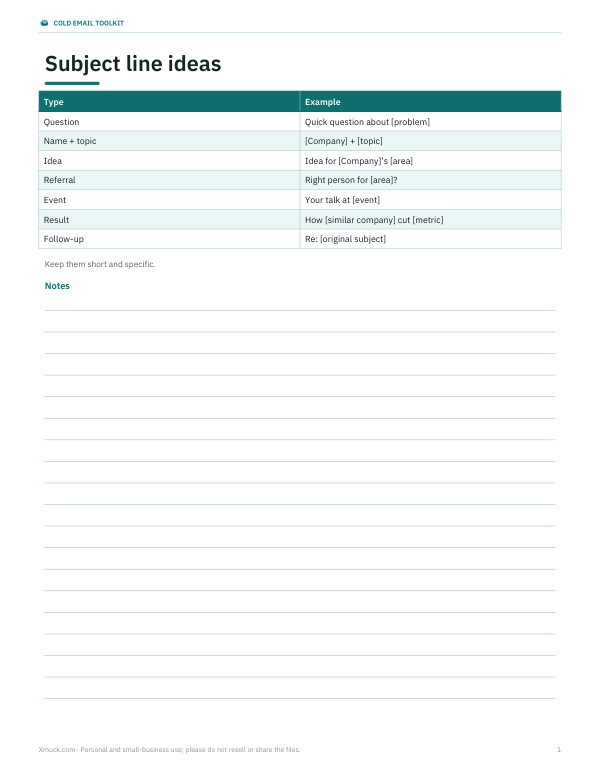
- Subject lines (PDF/DOCX)
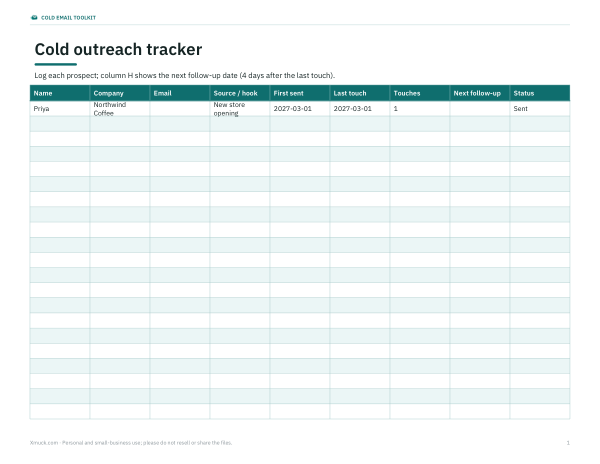
- Outreach tracker (XLSX)
- Research sheet (PDF/DOCX)
- Pre-send checklist (PDF/DOCX)
Formats: DOCX, PDF, XLSX. Instant download after payment (link valid 72 hours, up to 5 downloads). AI-assisted: the templates were drafted with AI help and reviewed and laid out before publishing.
$5.00 USD, one-time 5 files · about $1.00 each
- Instant download
- 7-day refund
- Secure checkout by Stripe
7-day money-back guarantee. Full refund within 7 days of purchase, even after you download.
Free sample: Cold Email Templates (PDF, 50 KB)
Full refund within 7 days — see the refund policy and license.
Free printables
Single sheets you can print right now, no sign-up. The full pack adds every sheet in one download plus the editable files.
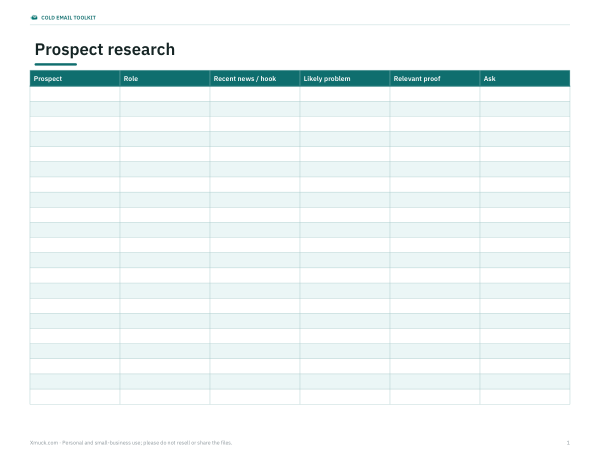 Printable Prospect Research Sheet
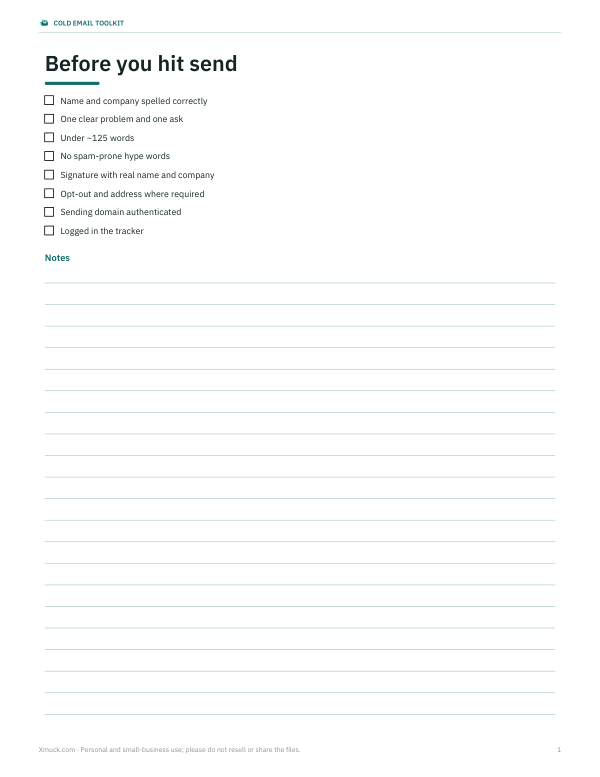 Printable Cold Email Pre-Send Checklist
What makes a cold email work
| Element | Good practice |
|---|---|
| Subject line | Short (often under ~50 characters), specific, no hype |
| Opening | About them — a relevant observation, not your company history |
| Problem | One problem they’re likely to recognise |
| Offer | What you do, in one plain sentence |
| Proof | A specific result, client type or credential |
| Call to action | One small, easy ask — a short call, a yes/no, or a resource |
| Length | Short enough to read on a phone in under a minute |
Frameworks
| Framework | Structure | Best when |
|---|---|---|
| Short and direct | Hook → what we do + proof → ask | You have a strong, relevant result |
| Problem–agitate–solve | Problem → why it hurts → your solution | The problem is widely felt |
| Value first | A genuinely useful tip → light mention of you → ask | Building trust with busy people |
| Referral / right person | Ask who handles the area | You’re not sure who to contact |
Worked example
Sam runs a small inventory-forecasting startup and wants to reach the head of operations at a regional café chain. In the builder he enters the recipient, the problem (stock-outs of best-selling beans), what his product does, one proof point (a 12-store chain cut stock-outs by a third) and a personal hook (their new store). The “short and direct” version comes in at under 80 words with a single question, the checker finds no spam-prone words, and two polite follow-ups are ready for day 4 and day 11.
Follow-up etiquette
- Wait a few business days before the first follow-up.
- Add something new — a short example, a relevant article — rather than “just checking in”.
- Stop after two or three follow-ups; a clear last note is courteous.
- Honour any “not interested” or unsubscribe request immediately.
- Keep a tracker so you don’t email the same person twice by mistake.
Rules and deliverability
Unsolicited commercial email is regulated differently around the world. In the US, the CAN-SPAM Act requires honest sender and subject information, a valid postal address and an easy way to opt out. In the EU and UK, the GDPR and electronic marketing rules place tighter limits on unsolicited marketing email, especially to individuals. This page isn’t legal advice — check the rules for where you and your recipients are. For deliverability, send from a properly authenticated domain (SPF, DKIM, DMARC), keep volumes modest and personal, and avoid link-heavy or image-only emails.
Subject lines that get opened
| Pattern | Example | Why it works |
|---|---|---|
| Specific question | Quick question about stock-outs | Signals a short, relevant email |
| Their company + topic | Northwind + inventory | Looks internal and personal |
| Mutual connection | Alex suggested I reach out | Borrowed trust — only if true |
| Relevant event | Your new Riverside store | Timely and personal |
| Result | How a 12-store chain cut stock-outs | Concrete outcome |
Avoid clickbait, fake “Re:” or “Fwd:” prefixes and all caps — they damage trust and can breach anti-spam rules.
Measuring results
- Track reply rate rather than open rate — privacy features in many email apps make opens unreliable.
- Test one change at a time: subject line, opening line or call to action.
- Send in small batches so you can learn and adjust.
- Note which industries and roles respond best.
- A handful of thoughtful emails usually beats hundreds of generic ones.
Cold email vs cold calling vs social outreach
Email lets busy people respond when it suits them and gives you space to include proof, but it’s easy to ignore. Calls get faster answers but interrupt people. Professional social networks let you warm up a contact first by engaging with their posts. Many successful outreach sequences mix channels: a short email, a connection request a few days later, and a final email — always respecting anyone who says no.
Personalisation that isn’t creepy
- Reference public, professional information: a company announcement, a talk or an article.
- Keep it to one line — the email is still about their problem.
- Don’t mention personal details from social media.
- If you can’t find a genuine hook, skip it rather than inventing one.
Privacy
Everything you type stays in your browser.
Frequently asked questions
How long should a cold email be?
Short — often under about 125 words — so it can be read on a phone.
What is a good cold email subject line?
Short, specific and relevant, without hype or all caps.
How many follow-ups should I send?
Two or three at most, spaced a few days to a week apart.
Is cold emailing legal?
It depends on where you and the recipient are; follow CAN-SPAM, GDPR and local rules.
What words trigger spam filters?
Hype words like “free”, “guaranteed” and “act now” can hurt — the checker flags common ones.
Is my text saved?
No. It stays in your browser.
When is the best time to send a cold email?
Mid-morning on a weekday in the recipient’s time zone is a common choice; test what works for your audience.
Should I use a template?
Use templates for structure, but personalise the opening and proof for every recipient.
How do I find someone’s work email?
Use their company’s published contact details or a professional introduction; respect privacy rules where you are.
What if they reply “not now”?
Thank them, ask if you can check back in a few months, and note it in your tracker.
Can I send attachments?
It’s usually better not to in a first email — offer to send a resource instead.